Bears are animals that are familiar to many people, having been portrayed in various forms and winning widespread affection. Unfortunately , it’s rare to encounter the smiling bears we see in cartoons in real life. Among them , theapproximately 370captive bears in South Korea reportedly spend their entire lives in cramped cages before quietly passing away.
Today, we met with"Bear Sanctuary," an organization that is bringing the issue of captive bears in Korea to the forefront and proposing"sanctuaries" asa solution.

“We gathered here to create a home for captive bears.”

Hello, I’m Do Ji-hye, an activist and designer at Bear Sanctuary . Bear Sanctuary is a project-based organization formed to put an end to the government-sponsored farm-raised bear industry that has been in operation since the 1980s.
Bear Sanctuary is made up of people from a wide range of fields, including environmental activists, college students, designers , and veterinarians . Drawing on their respective expertise, they are working to ensure that captive bears can live out the rest of their lives in comfort.
Our organization’s ultimate goal is to establisha “sanctuary”—a protective facility for captive bears—in Korea. However, due to current time and financial constraints, we are unable to build a sanctuary at this time , so we are focusing our efforts on protecting the bears that have been abandoned on farms.
Currently, we are prioritizing efforts to protect the captive bears at farms in Hwacheon, and we are continuing various activities—such as participating in forums in collaboration with other organizations— to bring an end to the captive bear industry itself.
“Do you know how the issue of captive bears began?”
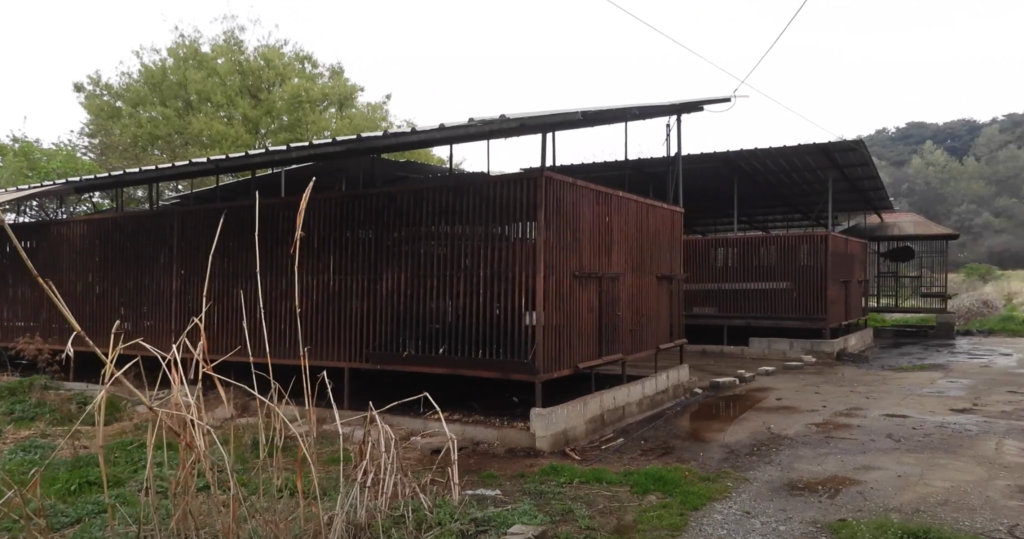
In Korea, bear farming began in the 1980sas a national industry aimed at boosting farm household incomes. However, following the 1988 Olympics , rapid modernization led to the protection of the Asiatic black bear—recognized internationally as a natural monument—making its import and export increasingly difficult.
Subsequently, as an alternative, they began harvesting bear bile so that farms could generate income from captive bears. Back when bear bile sold well, the steady income meant farmers had sufficient capacity to care for the bears. However, now that bear bile generates no profit whatsoever and the government has failed to provide follow-up support for this industry, farmers can no longer afford to care for the bears and have been forced to abandon them.


As of June 2021, there are approximately 369captive bears in South Korea. While the Jirisan Asiatic black bear is designated as a Natural Monument and is protected in a good environment through restoration projects, captive bears on farms— despite being Asiatic black bears— are neglected in cramped cages simply becausethey are considered a “subspecies”imported from Japan or Southeast Asia.
When you really think about it, aren’t all these problems caused by human greed? After all , these issues arose because we started raising bears to boost farmers’ incomes. Personally , I think that since humans are responsible for this, it’s only right that we take the lead in solving these problems and addressing them.
“The captive bears weren’t the bears I knew.”
For captive bears living in cramped quarters, the most important part of their daily routineis “eating.” Since they have nothing else to do all day but eat, the act of eating is considered a major event for them. That’s why , whenever they’re fed, the bears get very excited and often engage in repetitive behaviors like spinning in circles or shaking their heads. Seeing this in person is truly shocking.
These behaviors are referred toas “stereotypedbehaviors.” Stereotyped behaviors refer to the tendency of animals kept in isolation or confined to cages to repeat specific actions. Bears are naturally very active animals, but because their movement is restricted in small enclosures, they end up exhibiting stereotyped behaviors such as pacing in circles or repeatedly moving back and forth in the same spot.

Furthermore, since the farms cannot afford to purchase commercial feed, they are raising the bears on food scraps and expired food. The enclosures where the captive bears live have concrete floors, so many bears suffer injuries from cracks in the floor or are left to suffer from hair loss due to poor sanitary conditions.
“For captive bears, a sanctuary is not a ‘choice’ but a ‘necessity.’”
A sanctuary, meaning a place of refuge or rest , is a facility that protects wild animals with nowhere else to go, providing them with an environment that closely resembles their natural habitat. Since captive-bred bears are essentially animals that cannot return to the wild, humans create an environment that mimics nature and provide them with care—such as regular monitoring and health checks.
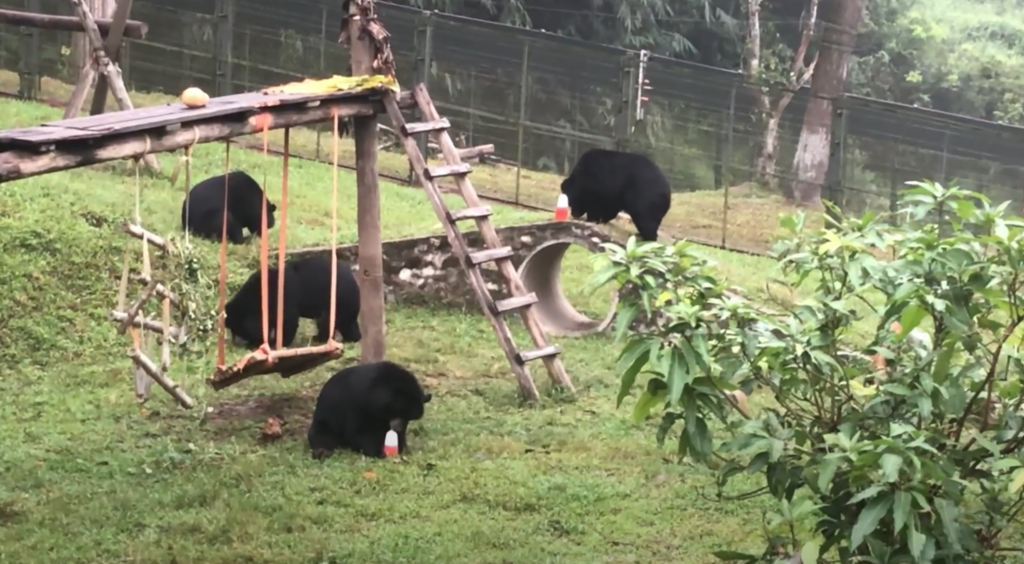
The key difference is that while zoosare “spacescreated for humans,” sanctuaries are “spaces created for animals.” Zoos are designed to display animals and allow humans to interact with them, whereas sanctuaries are spaces created with the animals’ safety and well-being as the top priority. For this reason , unlike zoos, sanctuaries provide areas where animals can freely avoid human gaze.
Many people wonder if captive bears could simply be released into the wild, just as some protected animals are. The reason sanctuaries are absolutely necessary for captive-bred bears is that, since they have never lived in the wild, there is a high probability they would return to residential areas if released into the wild. Furthermore , releasing captive-bred bears—which are a subspecies of the Korean Asiatic black bear—could potentially disrupt the ecosystem.
In fact, it’s nearly impossible for wild animals that have been domesticated by humans their entire lives to fully return to the wild. Since they haven’t learned how to forage for food or establish their own territory, they wouldn’t be able to survive if released into the wild, which is why reintroduction is indeed difficult.
“It’s most disheartening when there’s nothing we can do for captive bears.”
In Julyof this year, two bears escaped from a bear farm in Yongin . One of them was found 300 meters away from the farm just two hours after the escape and was shot and killed.

Over thepast decade, there have been about 20 incidentsof captive bears escaping, which amounts to roughly two incidents per year. The most heartbreaking part is that even when escaped bears were captured rather than killed, they had to be returned to the farms because there were no facilities capable of caring for them.
It’s the hardest part when these practical problems come right up against us. There are so many captive bears we need to protect, but even when we do rescue them, we often find ourselves in a helpless situation where we can’t solve the problem—even though we’re fully aware of it—because we simply don’t have the facilities to care for them.
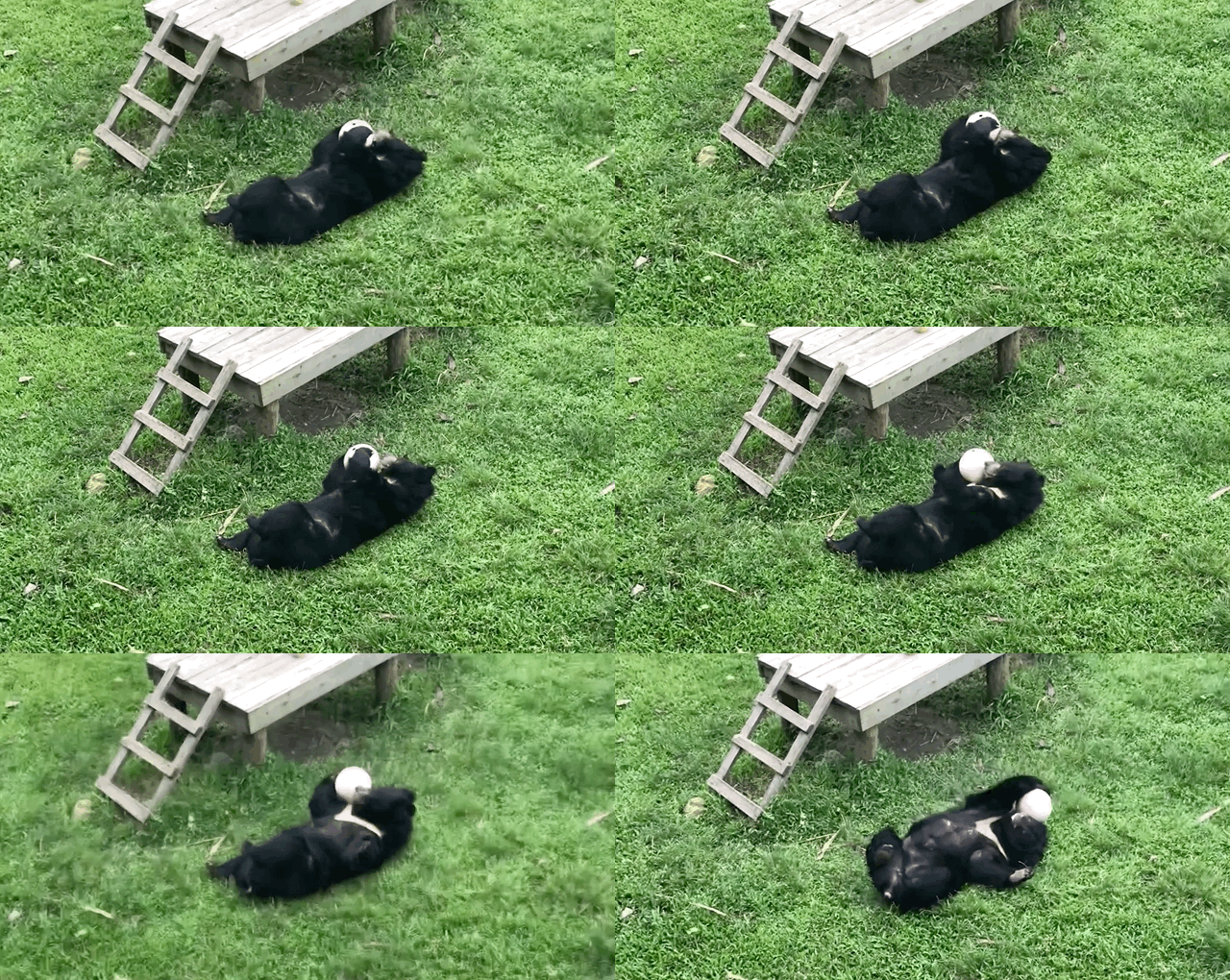
To address these practical challenges, even if only slightly, we launched a project to build our own sanctuary. However , since building a sanctuary is such a time-consuming endeavor, it’s emotionally very difficult to witness bears falling ill and dying while the project is still underway.
“For the day when captive bears can rest in peace, even for just one day”
Through our merchandise sponsorship Wadiz, we were able to naturally raise public awareness about the issue of captive bears. We plan to continue seeking practical solutions for captive bears through initiatives like this in the future .
In fact, even though we’re doing so much work, my heart aches even more every time I see bears living in conditions where we haven’t been able to reach them. That’s why I just hope that more sanctuaries will be established in our country as soon as possible. Our ultimate goal at Bear Haven is to create an environment where captive bears no longer die, but instead live safely and under protection.
See more donation and campaign projectsWadiz
Join the world-changing movement with the ‘Bear’s Nest Project’ by Jinguk-in
These bears, commonly referred to as “captive bears,” are actually Asiatic black bears. “BearHaven”simply hopes that these captive bears will be treated as Asiatic black bears— even if just for a single day—and live a life that is at least a little more comfortable. Please send a warm message of supportto “Bear Haven, ” which dreams of creating an environment where bears can freely walk on the ground and drink water, as we watch these bears find happiness in even the smallest gestures of kindness within their cramped metal cages!
Go toWadiz
Get Started withWadiz
The A to Z ofWadiz Go to Maker Center
Get Answers to Your QuestionsWadiz