What do you think design is? While everyone’s definition of design may differ, one thing is certain: the essence of design lies in planning and creating.
Wadiz, which provides services via the web and mobile apps, has product designers on staff. They work to improve existing features and design new ones
We met withthe Product Design Team, who are constantly striving to provide the best possible experience for our users.
What does a Wadiz product designer do?
Jin-seop: Hello, I’m Jinseop Lee from the Product Design Team. Wadiz, the engineering organization is divided into “bands” based on specific objectives to quickly solve problems and drive impact. Product designers belong to the Payment Volume, Open Rate, and Active Member bands. In the organization focused on increasing the number of transactions, I identify and define service issues, and design the user experience impact we aim to deliver. Although our team members belong to different bands, we work as a single team, regularly exchanging feedback.
Yunhye : Hello. I’m Park Yoon-hye, a Product Designer on the Active Members team. My role is to improve the service experience Wadizusers, particularly our supporters.
Yeon-kyung : Hello. I’m Park Yeon-kyung, a Product Designer on the Open Campaigns team. I help connect supporters and makers, and I design the entire process—from project preparation to reward fulfillment.
Joo Chong-myeong: Hello. I’m Joo Chong-myeong, a Product Designer. As Jin-seop mentioned, the Wadiz tech team is composed of Product Owners, Product Designers, Front-End (FE) and Back-End (BE) developers, App developers, and QA team members. I’m part of the Transaction Volume Team, where I’m working to improve the user experience—from navigation to checkout—on Wadizdesktop web and mobile apps. With the goal of increasing transaction volume, I’m constantly refining our service.
What are the most important skills and experiences for a product designer at Wadiz?
Jin-seop: I think it’s problem-solving skills, flexible communication, and the ability to collaborate. As a product designer, my role is to identify problems, derive insights, and solve them in order to deliver the best possible service. It’s not enough to simply identify problems; you must dig deep to analyze the root causes and make quick decisions. In this process requires the ability to propose effective solutions using various approaches, such as data analysis and user research, as well as A/B testing.
Yoon Hye: I believe it’s important to have the ability to see the big picture—from the “why” to the “how” of our work. Wadizhas several operational teams, each making various attempts to achieve their respective goals. Since these goals need to be reflected in our services, I believe it’s crucial to understand the business objectives and view our services through that lens.
Chongmyeong: I believe that the most important skill in any endeavor is the perspective from which you approach the task. For Wadiz product designers, I think these two things are particularly important. First, a user experience that takes into account not only data but also the potential for business growth. Second, decision-making that doesn’t obscure the essence of the task’s objectives.
From a business perspective, it’s crucial to integrate the elements you want to highlight into the service as seamlessly as possible. Of course, the ability to propose data-driven solutions is a fundamental requirement. However, if you don’t take the business into account, the product will struggle to succeed in the long run.
Second, it has to do with communication with relevant departments. Here, it’s important to adopt a mindset that advocates for the user. When we focus too much on differing interests, we sometimes lose sight of usability. Since this role is so closely connected to users, I believe we must take responsibility for usability. To achieve this, close communication and coordination between the business and development teams are essential.
What do you think is the most unique aspect of being a product designer Wadiz?
Jin-seop : Wadiz operates across various domains, providingan environment where supporters (users) and makers can thrive together. In this process , product designerscan create a unified user experience that encompasses every stage from both perspectives.We gain a deep understanding of how each domain connects and interacts, and we can find solutions to the problems that arise between them to bridge the gaps. What makes being a Wadiz product designer special is thatit goes beyond simple product design;it allows meto empathize with andconsiderboth user perspectives while understanding the connections between our services.
Yeon-kyung: We have a culture that encourages autonomy, allowing us to take full responsibility for projects from the initial planning stages through to deployment. You’ll gain a sense of accomplishment and responsibility by experiencing the entire project lifecycle—from defining service policies and designing user flows to communicating with relevant departments.
Chongmyeong: Band members can engage in more focused discussions to achieve our goals. I communicate most frequently with the Product Owner (PO) while working on projects. The PO has a deep understanding of the service and collaborates with me to devise solutions to the problems identified by the product designer and develop strategies together. If the development team needs specific data, they actively implement the necessary testing environments. Sometimes, they create prototypes first to help us easily identify issues that might arise during actual implementation. They also suggest efficient interactions tailored to both web and native environments.
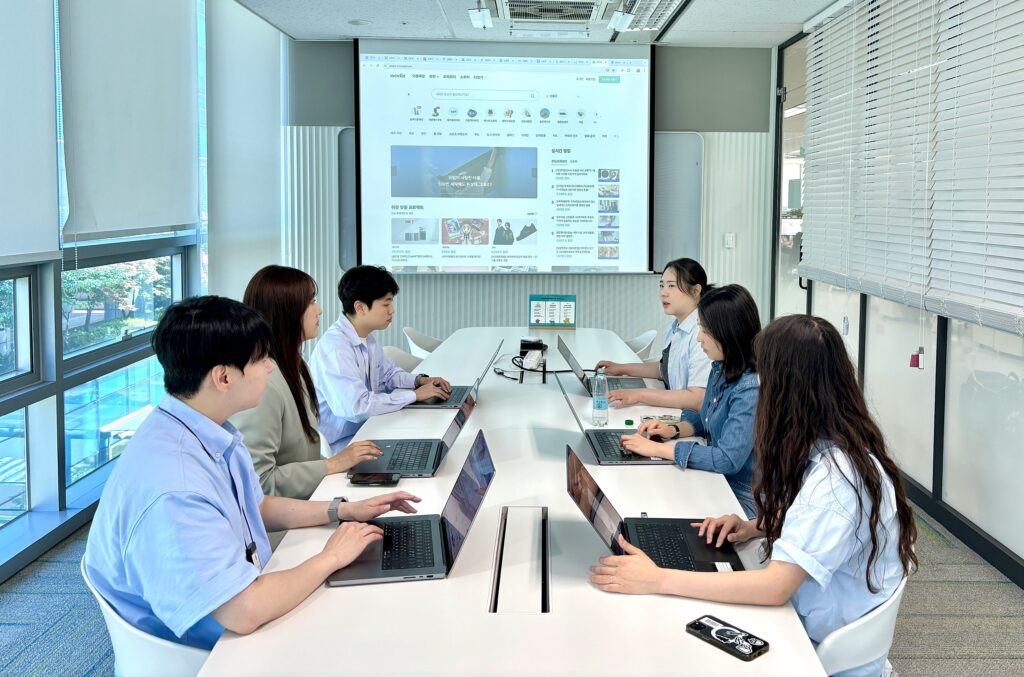
Wadiz Product Design Team
Does the Product Design Team have its own unique culture or way of working?
Jin-seop: While working within our respective teams, we’re designing experiences that span across platforms and domains. We hold weekly design meetings to ensure team alignment. We share the projects currently underway in each team, exchange constructive feedback, and manage design quality.
Yoon Hye: As Producer Jin-seop mentioned, during design meetings, we share the projects currently underway in each team. These meetings allow us to understand the challenges other teams are facing, and we exchange opinions on areas that could be improved from a designer’s perspective. We also identify connections between my project and others, proactively suggest ideas, and share feedback.
Chongmyeong: The Product Design Team follows one of Jin-gook’s work philosophies: “If you’re unsure, report it; if you’re not unsure, make the decision.”. When we have concerns, we exchange countless opinions even outside of meetings. Everyone actively contributes diverse perspectives, and since most of these are efficient solutions and sharp questions, we gain a wealth of insights. We understand and incorporate differing opinions, take responsibility for usability, and make decisions.
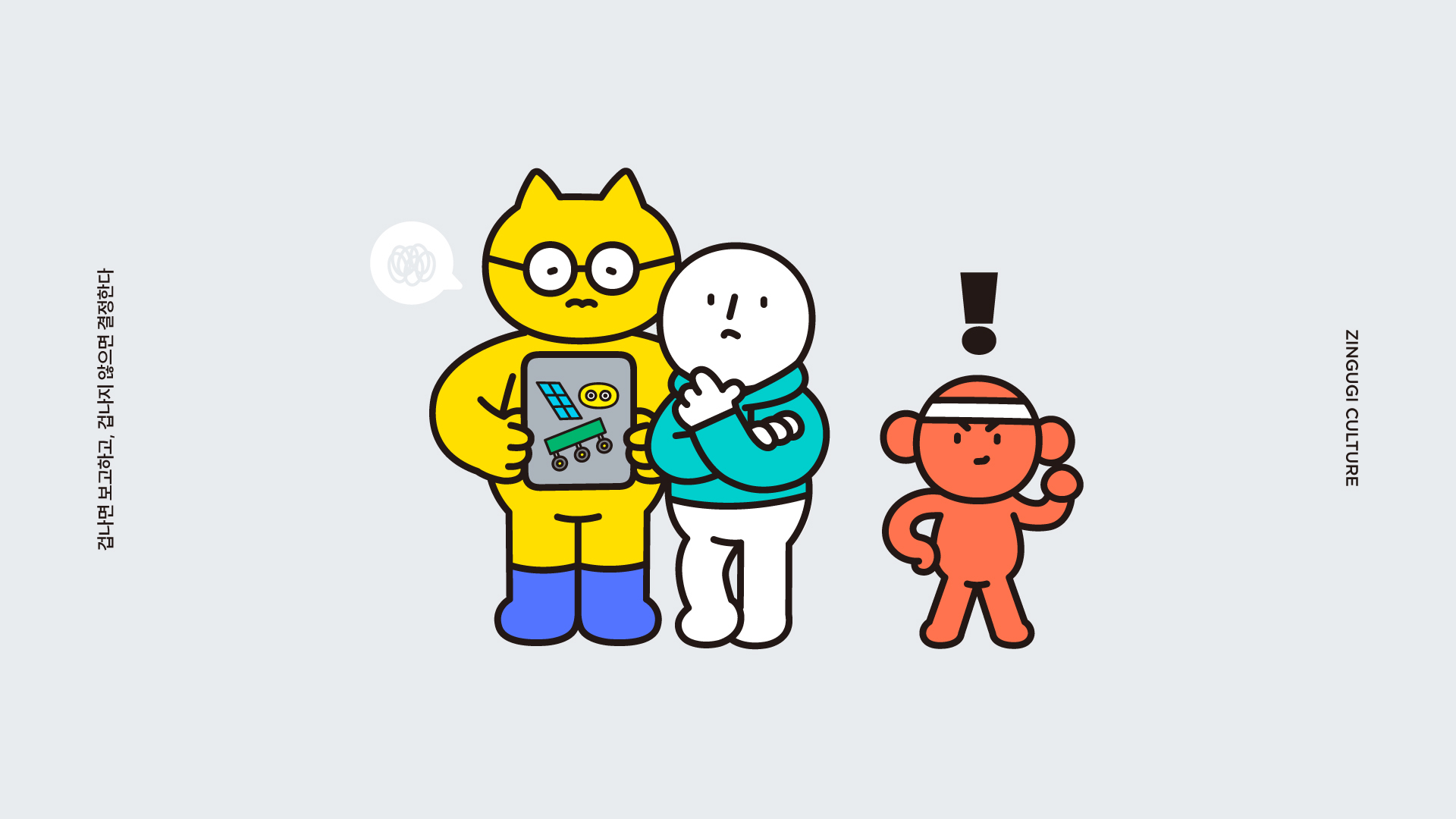
Jin-gook's Work Philosophy #7: If you're scared, report it; if you're not scared, make the decision
I understand that the Product Design Team uses a "design system." What is it, and why was it created?
Chongmyeong: Because of the title “product designer,” many people think the job is all about setting text sizes and colors, designing button shapes, and creating visually appealing layouts. While aesthetic elements are important, a product designer’s primary goal is to identify problems in the user experience and “design” solutions. The tool that enables us to create these solutions is is the design system (WDS).
Jinsub: In product design, consistency and flexibility are the most important factors. This is especially true for the Wadiz service, which spans various domains and user groups, making consistent experienceis key. The design system ensures that all design elements maintain a sense of unity. We are constantly updating and refining our design system so that we can respond quickly to changing requirements.
When it comes to design, I believe that a subjective perspective is the most dangerous factor. I strive to maintain a user-centered mindset. I incorporate feedback gathered through user research and testing into the design process, aiming to make design decisions based on data and actual user experiences.
Yoon Hye: I’m working to structure the screens using a design system. Since this involves not only design but also development, adhering to it ensures there are no issues with scheduling or communication before the service is actually launched. When designing, my approach isn’t just about creating visuals; I focus on whether the design helps achieve our goals and whether it can be developed efficiently.
Yeon-kyung: When developing a design system, efficiency is our top priority. It’s crucial to build an infrastructure that allows various stakeholders—including Product Owners, product designers, and developers—to focus on validating hypotheses more quickly. A design system is what makes this possible. Wadizis organized into several bands and task forces (TFs) based on specific objectives, and these teams move quickly to solve problems. In this context, a robust design system is essential for rapid execution.
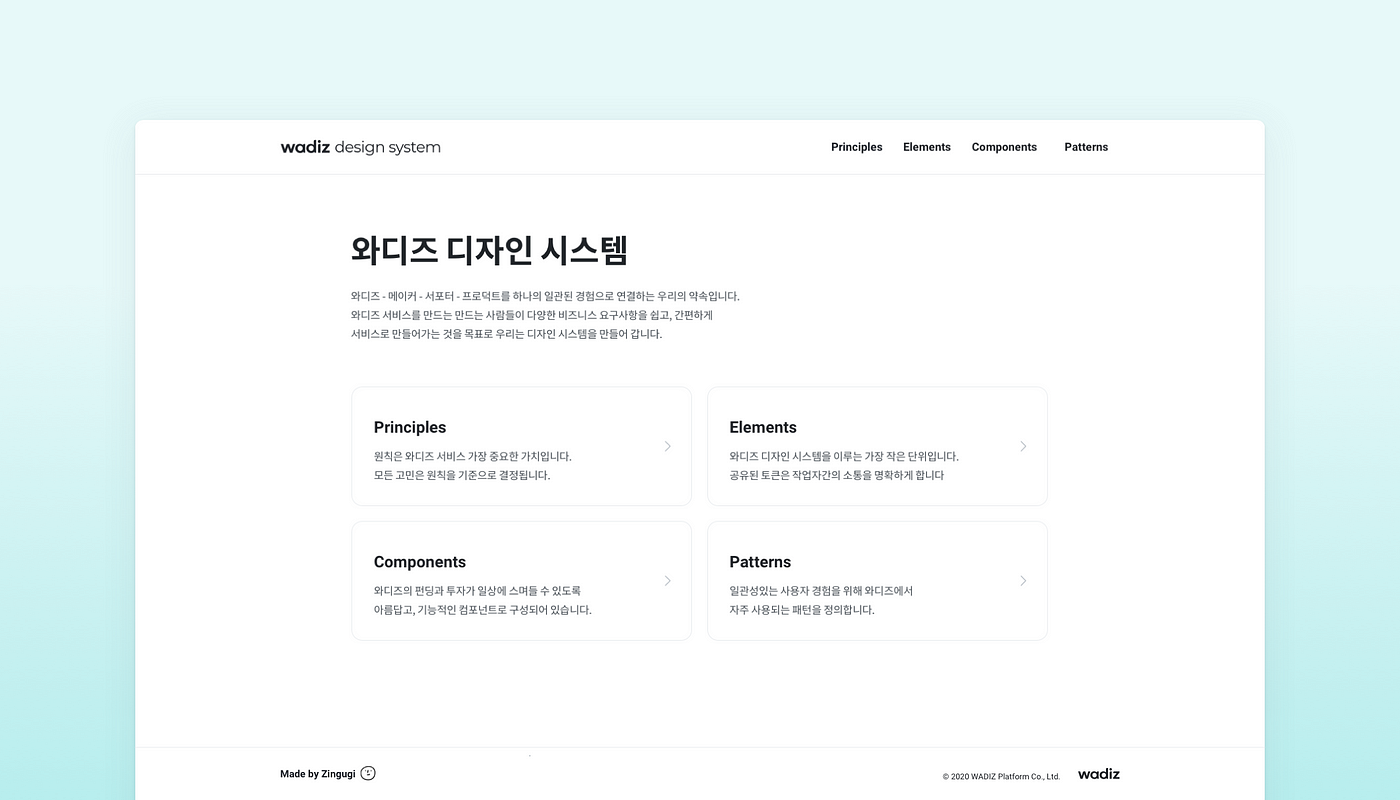
Wadiz Design System
What are the key priorities the Product Design Team plans to focus on moving forward?
Jinsub: Lately, our team has been focusing on refining our design system to respond quickly to changes in our services and business. We’re striving to maintain consistency and efficiency—from component usage policies to the interactions between components—to meet UI requirements. We’re working to manage these as shared modules.
I believe the Product Design Team’s mission is to design experiences that make a real impact on our services and business by collaborating with Product Owners, developers, and even the business team. I want to focus on fostering a culture where we can freely and constructively exchange ideas with our colleagues and create an environment where we grow together.
Do you still have questions? 👀
Want to know how to build a design system? 👉Click here
Want to know what positions we're currently hiring for? 👀
Top right corner of theWadiz blog Click!