At CES (Consumer Electronics Show), the world’s largest IT exhibition held in Las Vegas, U.S., this past January, a marine pollution control robot developed by a South Korean startup won an Innovation Award. Utilizing artificial intelligence (AI) technology, this robot moves in swarms across the ocean to recover pollutants such as oil and plastic. It receives coordinates from a drone flying overhead to locate pollution sites on its own, then collects and stores spilled oil. The developer of this robot is Park Kyung-taek (65), CEO of Koai. Having spent his entire career in the toy industry, CEO Park founded a one-man research firm in 2017 at the age of 58. He is now preparing for overseas exports, including conducting technology demonstrations with a state-owned oil company in the United Arab Emirates. “I drew inspiration from the fact that many of the industrial robots currently in use have functions derived from toys,” said CEO Park.
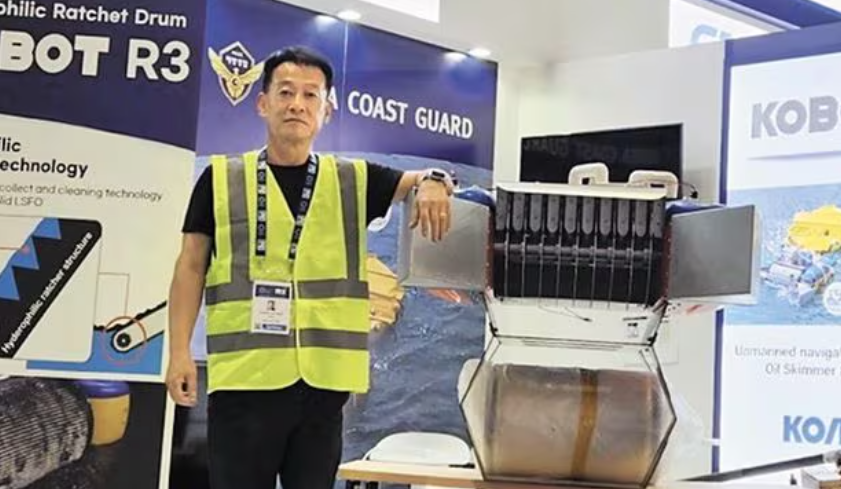
Park Kyung-taek (65), CEO of KoAI, is demonstrating the marine pollution response robot "Kobot." /KoAI
Middle-aged and older adults are entering the tech startup market, which was once considered the domain of the younger generation. In the past, startups by this demographic typically focused on retail and service industries, such as restaurants, coffee shops, and fried chicken shops. However, there is a growing trend, led by the baby boomer generation in their 50s and 60s—who played a central role in the industrialization era—to pioneer new markets by leveraging unique technologies and ideas. Kim Jeong-ho, a senior researcher at the Korea Institute for Industrial Economics and Trade, said, “Many members of the baby boomer generation have worked in fields requiring specialized skills, such as manufacturing,” adding, “Their ability to leverage their wealth of experience and know-how is a key advantage.”
Seniors Who Have Taken Over Crowdfunding
Kim In-ho (64), who founded the mattress company “Lux Nine” in 2011 at the age of 51, also received an Innovation Award at this year’s CES for his healthcare device “BodyLog.” BodyLog measures body tilt, exercise intensity (acceleration), and electrocardiogram (ECG) to prevent falls and detect sleep patterns and heart attacks in real time. Having previously served as the head of the Korean branch of the foreign-owned Sealy Beds, he drew inspiration for developing BodyLog from his experience in the bedding industry. “I spent years wondering what I could do to live well and be happy until I’m 90, and that’s what led me to start this company,” said CEO Kim.
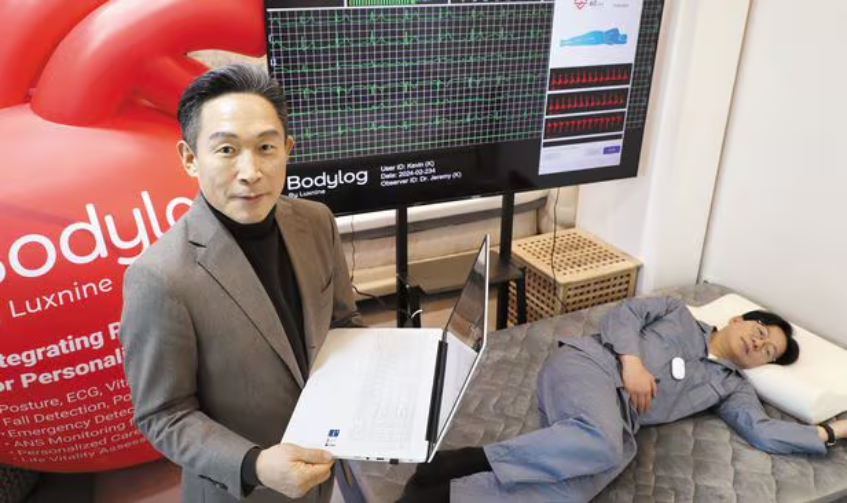
On the 4th, Kim In-ho (64, left), CEO of the Seoul-based startup LuxNine, demonstrated “BodyLog,” a comprehensive healthcare wearable device he developed himself, at the company’s office in Bangbae-dong, Seoul. Kim founded the startup at the age of 51 and received an Innovation Award at CES, the world’s largest IT exhibition, this past January for his digital healthcare technology specializing in posture. / Reporter Jeon Ki-byeong
The rise of middle-aged and older entrepreneurs is also evident in the online sphere. A prime example is “crowdfunding,” which involves raising investment funds for product or service launches from a broad, unspecified audience of internet users. An analysisWadizcrowdfunding platformWadizof the age groups of business owners who launched fundraising projects revealed that the proportion of those aged 50 and older—which stood at just 2.5% in 2014—has increased nearly tenfold to 22.7% as of January this year. When expanded to include those in their 40s, the proportion reached 53.3%, surpassing the proportion of those in their 30s and younger (46.7%) for the first time. A Wadiz representative stated, “Since their long-standing expertise serves as a marketing advantage in itself, the response to their funding campaigns has been positive.”
The reason middle-aged and older entrepreneurs are flocking to crowdfunding is the difficulty they face in securing funding. Many public and private startup support policies are focused on young entrepreneurs in their 20s and 30s, and it is also difficult for them to secure venture capital. According to a 2022 survey by the Korea Institute for Industrial Economics & Trade of 222 middle-aged and older tech startups, these entrepreneurs cited “difficulty securing startup capital (42.3%)” as their biggest challenge.
Tech startups founded by people in their 40s are also on the rise
The startup industry anticipates that the proportion of middle-aged and older entrepreneurs in the tech startup market will continue to grow. There is also a rising trend in entrepreneurship among people in their 40s, who serve as a bridge between younger and older generations. Baek Jae-woo (46), CEO of Honeywell Smart Home Care, left his job at a heating parts company to develop an IoT-based meter and mobile app that provides real-time updates on heating costs. This product won the Minister of Land, Infrastructure and Transport Award last year. Kim Jae-han (47), CEO of Festival On, is an event specialist who worked as a club DJ for 20 years, but in 2022, he founded a startup developing AI solutions and generated 2.2 billion won in revenue last year. The company’s flagship product is an AI solution for event and area management that uses Wi-Fi and GPS signals to track the number of people and their movement patterns in crowded locations, thereby preventing accidents. CEO Kim said, “I originally majored in computer engineering but dropped out; I re-enrolled in the Department of Artificial Intelligence Software at the same university to start my business,” adding, “Thanks to my long experience walking around event venues, I was able to develop AI technology suitable for the field.”
(Original title: “Innovation Isn’t Just for the Young” – Middle-Aged and Older Entrepreneurs Are Making Their Mark)