
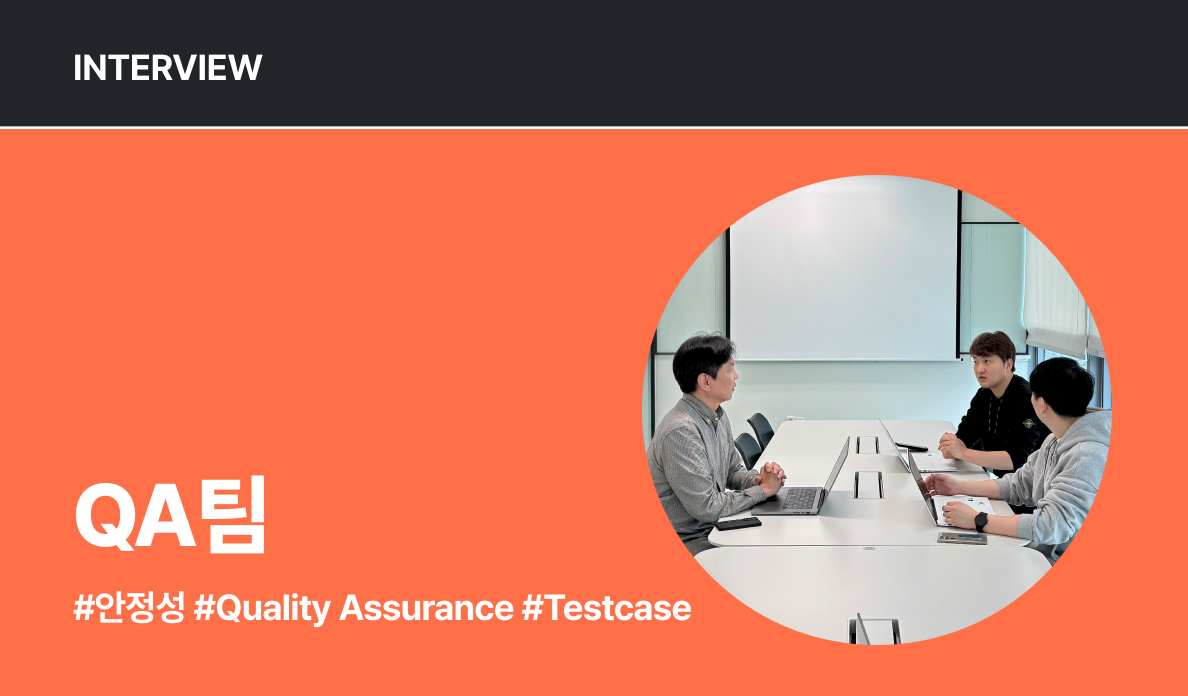
Before the Wadiz service reaches users, there’s one final team involved. This team is responsible for ensuring the quality of our unique services and development deliverables across a variety of environments.
We’d like to introduce the QA team, which is responsible for ensuring the stability of Wadiz with the goal of maintaining and improving quality.
Wadiz Please tell us about the QA team and their responsibilities.
Sung-kyu: Hello, I’m Shin Sung-kyu, Manager of the Wadiz QA Team.
The QA Team is responsible for providing stable services to both internal and external customers across Wadiz web and app environments. Within our technical organization, we work closely and flexibly with the service planning, design, and development teams, primarily conducting QA activities for strategic and operational development projects of all sizes.
Sang-woo: Hello, I’m Sang-woo Han from the QA Team’s Open Projects Group.
"Open Projects" is a metric on Wadiz that indicates the number of projects currently open and in progress by makers. Lately, I’ve been conducting QA verification on the key features and the connection between Maker Studio and Wadiz.
Ho-yul: My name is Lee Ho-yul, and I’m in charge of QA for advertising products. My main responsibilities include conducting quality testing for strategic initiatives, managing bugs, and identifying and addressing issues from the user’s perspective.
What are the most important skills and experiences for a QA specialist Wadiz?
Sung-kyu: In QA, user scenarios and use cases, we need to take a multifaceted approach that considers both business and technical specifications. To produce these deliverables, we frequently need to communicate with other departments. Smooth communication skillsis crucial. It’s also necessary to approach various scenarios from the customer’s perspective.
Next, you must be able to coordinate and manage the schedule effectively while prioritizing quality stability. You need the planning and design skills to resolve balancing issues so that you can identify appropriate solutions based on the volume and complexity of the task, achieve the necessary coverage, and deliver on time.
It’s also important to consider how to improve efficiency in QA work. The QA team are holding retrospectives with team members to identify and address inefficiencies in QA activities, not just in terms of test automation.
Sang-woo: I think there are three key competencies. First is problem-solving ability. We need the ability to identify and solve problems in order to maintain and improve the quality of our products and services.
Second, accuracy and attention to detail. I believe that accuracy and attention to detail are essential for ensuring that products and services meet customer expectations and maintain high quality. These are particularly important skills for tasks such as writing test cases, conducting tests, and reporting bugs.
Third, teamwork and collaboration. The QA team works with various departments to improve the quality of our products and services. Teamwork and the ability to collaborate with other teams are also essential.
Does the QA team have its own unique culture, work style, or communication methods?
Sung-kyu: Before we begin QA, our team considers the task from the user’s perspective, based on questions and a deep understanding of the task’s essence. In a relaxed atmosphere, team members exchange helpful questions and answers to determine the test plan and direction.
To make QA activities more productive and efficient, within the team retrospectivesto make our QA activities more productive and efficient. We conduct these retrospectives in a way that supports both the team’s growth and the personal development and growth of individual team members.
Beyond our regular work, we continue to engage in activities aimed at strengthening our QA skills—activities that reflect our team members’ personal interests. It’s an environment where everyone is respected—from casual conversations we wouldn’t normally have to the concerns we have about our professional growth. I truly believe this atmosphere, where we strive to balance work and personal growth, is something we can be proud of!
Sang-woo: It’s an environment where you don’t have to be afraid if there’s something you don’t understand—you can work confidently once you’ve fully grasped it. To ensure we fully understand our tasks, we communicate with relevant departments across various channels. In particular, when communicating, we always place great importance on asking “Why.”
Ho-yul: The QA team isn’t content to stay where we are; we’re always striving to improve. If you have a desire to change and grow, the team will actively support you.
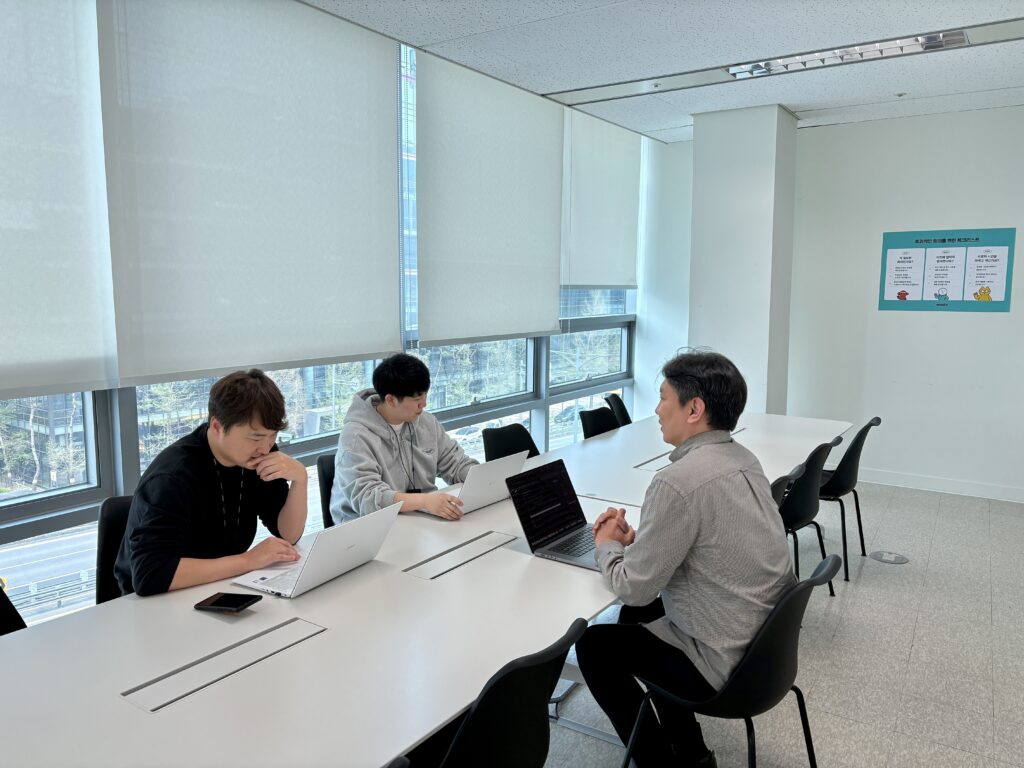
Wadiz QA Team
Is there anything unique about working on WadizQA team?
Sung-kyu: At Wadiz, the QA team offers the opportunity to gain experience in all aspects of validation, including UI, API, and data. You’ll design test plans tailored to specific development deliverables and targets, and take the lead in determining the approach and selecting the tools to use. You’ll experience a virtuous cycle where you brainstorm with teammates, reflect on your work, and implement improvements.
Another advantage is that we can freely discuss work-related matters with the planning and development teams at any time. We offer suggestions not only regarding risks identified through analysis and design but also regarding the verification schedule, and we respect each other’s opinions.
Ho-yul: Wadiz QA is currently in the early stages of implementing automation. If you’re interested in automation, I think this is a great opportunity to gain a variety of hands-on experience.
Do you have any personal beliefs or principles that you always try to follow at work?
Sung-kyu: I can relate to all 10 of Jin-gook’s work habits, but three of them really resonate with me.
First, “Work with a sense of priority and see every task through to completion.” In any organization, it’s important to clearly define tasks. In QA, in particular, it’s crucial to recognize importance and severity. Prioritization—such as determining “how to contribute to the stability of service quality”—is a key element in ensuring thorough completion.
Second, “I create a lot of homework that no one has assigned.” It’s rare to find someone who enjoys creating their own homework. The key point of this principle lies in the attitude of “always learning from everything.” I believe that taking the initiative to create your own homework stems from this mindset of always seeking to learn from everything.
Third, “Rest well to work well.” This single sentence can be interpreted in various ways. Of course, it refers to rest for both the body and mind. I believe it also encompasses the process of learning and preparing to tackle the next task effectively, or to ensure both quality and efficiency. I believe this process not only reduces the burden of the next task but also allows you to feel more engaged and complete your work with a sense of fulfillment.
Sang-woo: I always keep in mind one of Wadizfive principles: “We leave a positive impression on our partners and customers.” The QA team always does its best to ensure that customers and users are left with positive memories. We go beyond simply resolving issues; we think about improvements based on user convenience and the elimination of inconveniences. We don’t just act as testers—we approach our work with a deep commitment to QA (Quality Assurance)!
Ho-yul: Among the five principles, I place the highest priority on “meeting the needs of team members.” I believe that means being someone who does their job well and is a pleasure to work with. I believe this is the path to improving the quality of our work.

Jin-gook's Work Ethic #3: If you don't know something, ask anyone.
Is there a particular project or task that stands out in your memory?
Sang-woo: The project that stands out most in my memory is the “Pre-order Renewal.” It was a project to launch a new service. Since it involved multiple departments and Wadiz, it required a lot of communication and various validation methods. The schedule was tight, so close communication with my colleagues was essential. It really stands out in my memory because we were able to resolve issues effectively through regular meetings and communication.
Ho-yul: I remember the work I did to improve the Stage operation process and the exploratory testing process for regular deployments. In particular, the improvement of the exploratory testing process began with the question, “How can we ensure quality for development tasks deployed to production without QA?” Once the process was established and implemented, the results were immediately visible. It was a rewarding experience that helped steer the project in a better direction for the company.
What kind of new colleagues would you like to work with in the future?
Sang-woo: We’re looking for someone who can consistently provide feedback on process improvements and the adoption of new technologies needed for QA work. If you’re someone who can take the initiative and handle tasks independently, and who possesses strong communication skills, you’re more than welcome to join us!
Ho-yul: TheWadiz QA team offers endless opportunities to fully showcase your abilities. If you’re passionate about growth, you can grow to your full potential with us Wadiz. You’re always welcome!
Want to know what positions we're currently hiring for? 👀
Top right corner of theWadiz blog Click!



